Floating Islands
Six tropical islands held aloft by columns of cyan energy in noon sun above an endless sea, ringed around a humming alien craft you can take the helm of. Scroll the cinematic ascent, then drop into the cockpit and pilot the ship yourself — first-person or chase-cam, twin plasma cannons, a turbo drive that warps the world around you, and a battle mode where two krakens wake at opposite corners of the sea and hunt you with homing orbs — shoot them down with rainbow cannons that auto-upgrade as your kills climb, and clear 100 to win. Plus a music-synced dance mode, a 22-second aerial lap with real jet physics, and a chameleon island past the horizon pretending not to notice the krakens. Scored to Pineapple Static.
The Ascent
Inspired by Studio Ghibli's floating-world aesthetic and the soft, sun-bleached palette of a tropical lagoon. Every element — the foam rings collaring each island, the swirling columns of energy holding them aloft, the reef schools drifting beneath the surface, the slow heartbeat of the alien craft at the centre — is tuned to feel alive without ever being busy.
The journey unfolds vertically. As you scroll, the camera climbs through six cinematic waypoints — First Sanctuary, The Garden, The Quarry, The Outpost, The Grove, The Crown — and lands at The Helm, where the controls become yours. Press SPACE to glide between them; tap a dot on the right edge to jump anywhere.
The alien craft at the centre is always alive — a high-frequency micro-vibration shimmers it across all three axes so it reads as a hovering machine with engines running, layered on a slow swell-bob like the air itself has weather. Tap it and the vibration revs sharply for a heartbeat before three energy beams fire from the core and outer arms, concentric shockwaves ripple across the water, and the craft lifts on a seven-second arc above the islands before settling back. Click and drag to spin it.
Out past the arch, two krakens loom at opposite corners of the disc. The first hauls itself out of the water in the far southeast — bulk half-submerged, tentacles curling above the surface, head tilted toward the islands. A second, even larger, lurks half-sunk in the far northwest, only its upper body breaking the surface. Neither moves; neither needs to. From most cinema waypoints you only catch a silhouette through the haze; from The Crown and The Helm the near one anchors the southeast horizon. The wayfinder boundary system knows it by name: bump too close in cockpit and the toast reads "The kraken is sleeping."
Take the Helm — Wayfinder
Click wayfinder in the nav. The screen folds into a BOOTING WAYFINDER cockpit handshake — the whole sequence plays inside an octagonal alien-glass canopy that echoes the cockpit window, framed by a glowing rim, with concentric reactor rings, a system-online checklist that ticks each subsystem to OK in turn, and a progress bar filling across the boot. That's not just theatre: behind the curtain the renderer is compiling every shader, uploading every buffer, and running each flight system's real spawn path once — so the cockpit you drop into is already warm and runs smooth from the first frame. The camera glides in, the controls fade up a beat later, and the ship is yours.
WASD thrust, mouse look, space ascend, shift descend, QE roll. The ship auto-banks into turns. Soft cushion zones around every island, the arch, the chameleon's rock, the kraken, and the outer cylinder push you back if you press too far — each one with its own toast line. Three jet engines emit white-hot plasma plumes behind you that streak as you build speed.
Hold R-click for the twin pulse laser — a bright saber core inside a saturated plasma rim, every shot cycling through a six-colour palette pulled from the island energy beams. Hold L-click for the heavy burst cannon — a big plasma orb wrapped in counter-rotating halo rings, branching lightning arcs and a comet tail, cycling its own colours, with a three-layer water splash on impact. Both auto-upgrade as your kills climb (below): bigger, faster, fanning into more beams — tuned so the colour stays crisp and readable instead of washing to white as they multiply. T engages turbo: FOV punches wide, speed streaks rip past the cockpit edges, the screen warps outward in a continuous radial blur with chromatic aberration at the periphery — sustained hyperspace travel, not a one-shot punch. G-force jitter rides the camera through it. T again releases.
Press B for battle. Both krakens wake — a red glow swells over them — and they start launching pursuit orbs at you from opposite sides: eldritch things with a burning eye that tracks your hull, pulsing red flesh laced with veins, a translucent jellyfish membrane, lightning crackling off the shell and an inky trail behind. They home in and chase, fast enough to keep the pressure on but just shy of your top speed, so you can outrun them — or wheel around and shoot them out of the sky, where they detonate in a shock ring and a spray of embers. Every 20 kills your cannons auto-upgrade a tier — louder, wider, more beams; clear 100 and a WINNER card drops you back into free flight with your fully-maxed rainbow cannons kept hot for a victory lap (they reset when you leave the cockpit). Let an orb reach you and the hull takes a hit (red screen-edge flash, chromatic punch, camera shake); three hits and the ship is destroyed, then the encounter resets in place. B again stands down and the krakens settle.
V swaps between first-person cockpit and third-person chase cam — the ship hull goes solid in chase mode, translucent around you in cockpit. The organic HUD shows velocity, altitude, heading, a banking artificial-horizon arc, an iris reticle, and a live sonar dial centre-bottom that paints every contact around you — islands, the arch, the lizard island, and (in battle) the krakens and their inbound orbs as pulsing red blips, its sweep speeding up and going red when combat is hot. A defense readout tracks hull and kills, and an i button top-left (or the I key) pops the full control list any time. ESC exits cleanly; alt-tabbing out of the tab drops you back to explore mode automatically so the cockpit isn't running while your attention's elsewhere.
Three Detours
Three small italic links sit ready in the top nav from any chapter: ✦ island vibes, ✦ dance, and ✦ fly. Each takes the journey somewhere different and brings you back exactly where you were.
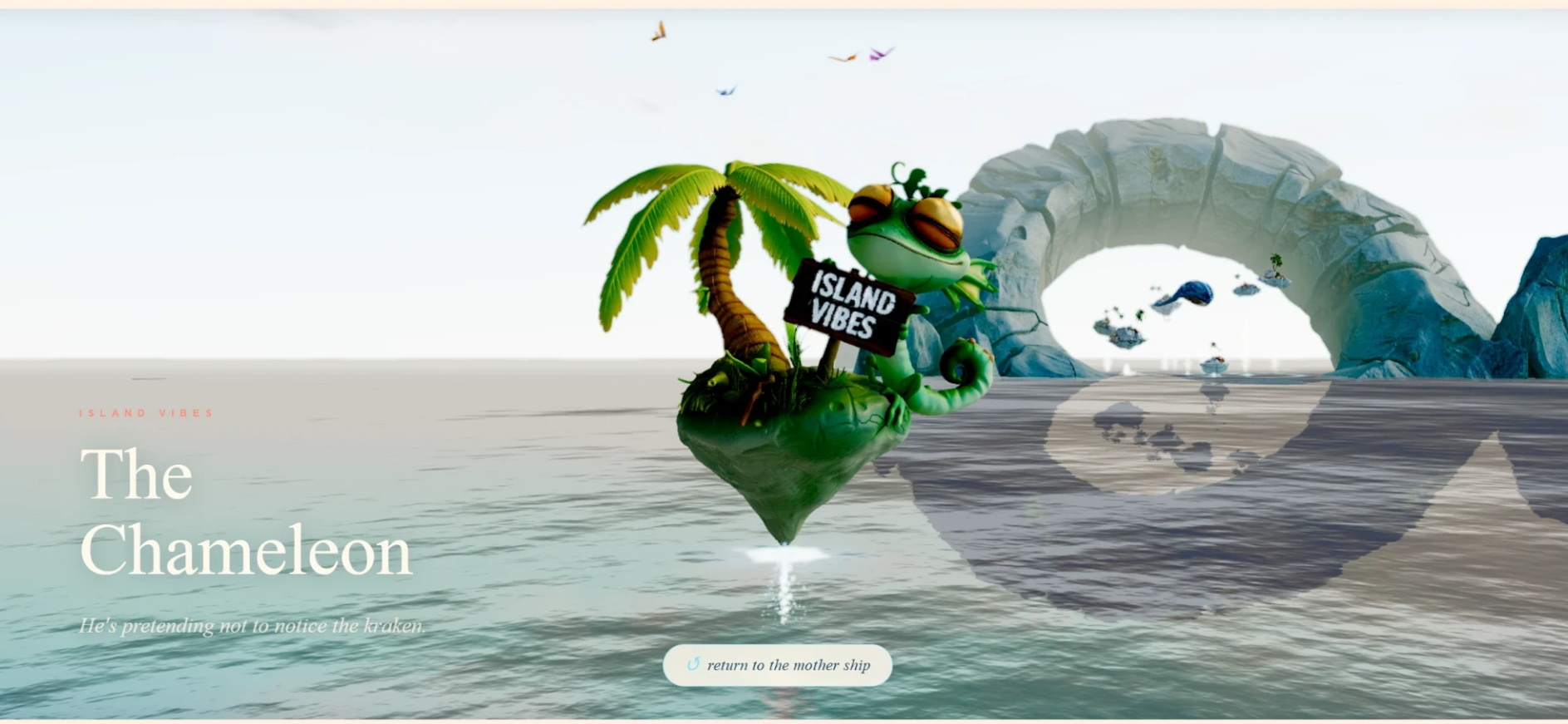
Island vibes arcs the camera out across open water in a single smooth three-second curve and lands you at a tiny island far past the others, where a chameleon in sunglasses stands beside a hand-painted ISLAND VIBES sign — the kraken framed behind him in the water through the arch, tentacles curled, head turned the chameleon's way. He's pretending not to notice. The arch and the main archipelago reflect across the calm. Stay as long as you want. Return to the mother ship drops you back exactly where you came from.
Dance glides the camera into a low cinematic orbit and the craft starts to dance. A live Web Audio analyser splits the song into bass / mid / high bands and pipes them into the visuals — the craft tilts and rolls into the music, bounces on bass kicks, traces a slow figure-eight; energy beams pulse with the lows; halos fire on the beat; water ripples spawn on every cymbal; three colored strobe lights orbit the craft. A drop detector watches the bass and punches into a quick rise / dip / triple-shockwave move when the song breaks. Scroll dials the orbit zoom in or out.
Fly sends the ship on a 22-second aerial lap with real jet propulsion physics — wingtip vortex cones spiral off the wings during hard banks, heat shimmer ripples through the engine wake, asymmetric thrust visibly throttles engines up and down to bank the ship, shock-diamond stripes appear in the beams at peak throttle. The camera chases with Dutch tilt and sub-pixel G-force shake, punches in to a close hero portrait of the chameleon as the ship streaks past his island, then arcs wide around the stone arch before spiraling home. Hit stop mid-lap and the ship tweens back to its takeoff spot.
The Tech
Built on Three.js + WebGL. Everything is generated or composed at runtime, then served as a single static bundle:
- Ten hand-built 3D models — six unique islands averaging ~1.9 million triangles each, the alien craft, a half-submerged stone arch, a tiny far-flung island for the easter egg, and a kraken sculpt placed twice: a 4,200-unit one hauling out of the water in the far southeast and a larger ~6,500-unit one half-sunk at the opposite corner (originally 60 MB raw — Draco compression got each down to ~6 MB; desktop only, since even decompressed the silhouette fragment-shader cost overwhelms mobile GPUs at cockpit altitude). ~17M triangles in the scene, all delivered via Draco mesh compression at roughly a sixth their raw size, with a per-asset progress loader so nothing pops in after the scene appears.
- Wayfinder cockpit mode — first-person + chase-cam piloting for the alien craft. Custom ShaderMaterial plasma weapons (fresnel rim + electric flicker + counter-rotating halo rings + branching lightning arcs) — every shot cycling a six-colour island palette and auto-upgrading through four tiers as kills mount, hue-saturated so the beams stay readable rather than washing to white as they multiply, a 240-particle Points engine trail emitting from three jet positions, a 160-segment LineSegments speed-streak field rushing past the cockpit during turbo, an organic HUD (iris reticle, SVG arc horizon + velocity gauge, canvas sonar dial) updated per-frame from physics state, and a cylinder + 15-sphere shell boundary system — overlapping collision spheres with quadratic+cubic bounce force, dense enough to make tunnelling impossible at any speed without the per-frame mesh raycast that used to cost a frame-hitch near the arch.
- Frame-perfect pre-warm — the BOOTING WAYFINDER loader is also a GPU warm-up rig. Behind a cockpit- shaped canopy it compiles every Wayfinder shader, force-runs the two postprocess passes that are otherwise skipped while disabled (so they don't compile on first turbo / first hit), uploads every canvas texture, and runs each flight system's real spawn path once — engine burst, vortex emission, orb + explosion draw — then renders several frames through the full composer. Combined with removing all per-frame allocations and the redundant arch raycast, the cockpit holds a steady frame from the first input through battle, leaving headroom for more effects.
- Battle mode — press B and both krakens wake (pulsing emissive halo + a single counted-from-load point light each, so no light-count recompile) and launch homing pursuit orbs from opposite corners: three layered ShaderMaterial shells (ship-tracking eye core, vein-laced flesh, translucent membrane) plus crackling lightning + an inky trail. Steering AI caps just under ship speed. Beams register via a swept segment-vs-sphere test so nothing tunnels through at full fire rate; kills detonate a shock-ring + spark burst. Lasers auto-upgrade every 20 kills; 100 clears the level and a WINNER card returns you to flight with weapons kept hot. A postprocess damage pass (red edge vignette + chromatic punch) auto-enables on impact; three hits destroy the ship and reset the encounter in place. The sonar flips to a fast red sweep with both krakens + orbs as live blips.
- TurboWarpPass — a screen-space postprocess shader that fires on T-press and runs continuously while turbo's on. Six-tap radial blur from screen center outward with a periphery-only mask (center 8% stays crisp so the reticle reads). Radial chromatic aberration: red shifts inward, blue shifts outward, scaled by edge distance. A periphery saturation crush adds the "hot energy throughput" feel. Strength ramps with an eased turbo blend; pass auto-disables when blend hits zero so it's free outside of turbo.
- Music-synced dance mode — Web Audio
AnalyserNodesplits the soundtrack into bass / mid / high every frame. Bass drives body bob + beam intensity + emissive flash + halo-beat triggers; mid drives roll-lean + spin + camera shake; high drives water scan-ring spawns. A slow EMA detects musical drops and fires a quick-rise / dip / triple-shockwave move. Continuous animations read a low-pass-filtered signal (~280ms time constant) so motion follows the song's phrases rather than per-frame analyser jitter. - Scripted aerial lap (fly mode) — 30-waypoint
Catmull-Rom spline with a sin0.4-minus-Gaussian-dip
velocity profile. Orientation derived live from velocity:
yaw from
atan2(vel.x, vel.z), pitch from vertical velocity, roll from clamped lateral accel. Real jet propulsion physics: differential wing thrust (the outside-of-turn engine throttles up to bank the ship), 200ms spool inertia, procedural shock-diamond stripes at peak throttle, gaussian plume taper, GPU-side wingtip vortex cones spawning during hard banks, a heat-haze postprocess that distorts UVs behind the engine wake. - Eight reef-fish species, ~107 individuals — boids physics, cross-species avoidance, banking + pitch swimming, tail animation locked to swim speed. They scatter when the craft fires and drift back over seconds.
- Procedural butterfly clusters — 24 around the main islands + 5 at the chameleon island. Each is a 25-vertex two-lobe model (forewing + hindwing + clubbed antennae). Wings flap at ~10 Hz with an asymmetric 40 / 60 stroke and a torsional wing-twist wave propagating tip-to-root each reversal. Random pitch (±29°) and roll (±43°) per butterfly so the cluster reads as 3D bodies at varied angles. They scatter with quadratic outward repulsion when the craft sweeps within 280u.
- Three-layer particle energy beams under every island, each on its own pulse rhythm. Tap-triggered triple beam on the craft — core + two outer arms, yaw-locked so they track as it spins — lifts it to apex altitude on a seven-second arc.
- Always-alive idle — four prime-ratio sines per axis on the craft, golden-ratio frequency stack so the loop never visibly repeats. Click-time rev-up envelope amps the vibration 3.5× for a quarter-second before the lift.
- Custom water shader with reflective mirror, FBM foam rings collaring each island, painterly tropical sky, ACES tone mapping tuned for saturated noon color rather than wash-out.
- Scroll-driven cinema — hand-tuned waypoints, auto-descent intro, spacebar glide, fly-from-anywhere tween when you jump to a chapter mid-explore. Soft + hard camera leashes mean you can't clip a model, dip below water, or drift off the world.
- Easter-egg flight — single 3-second cubic Bézier arcs the camera over the arch to the chameleon island. Pre-flight pose / cinema progress / scroll position are snapshotted bit-for-bit; return to the mother ship restores exactly where you were.
- Ambient soundtrack — Pineapple Static loops at low volume; ducks down during wayfinder so cockpit SFX read cleanly. Mute toggle persists across visits in localStorage. First user gesture unlocks autoplay.
On a Phone
iPhones have plenty of power but a famously narrow window of GPU memory per browser tab — around 256 MB before Safari quietly reloads the page. Seventeen million triangles decompressed into vertex buffers don't fit. So the mobile build is rebuilt from the same source with a lighter footprint:
Stripped: the half-submerged stone arch (its Draco GLB alone decompresses to a ~50 MB vertex buffer that pushes Safari past the cliff), both krakens (Draco got the files small enough to load but the fragment-shader cost at low cockpit altitude still tanked the iPhone 15 Pro), the 107-fish boids shoal, the heat-haze postprocess pass, and the wayfinder cockpit (mouse-look + WASD don't translate to touch — built for desktop only). Shrunk: three of six islands, scrolled chapters, foam rings, energy-beam particle counts (~half), the water mirror (768 vs 1024).
Kept whole: the alien craft tap-to-power interaction, dance mode with its full music-synced light show, the 22-second fly-mode aerial lap with real jet propulsion physics (differential thrust, spool inertia, shock diamonds, plume cone taper), wingtip vortex cones during hard banks (180-particle pool — costs essentially nothing), butterfly clusters drifting through every island (~425 verts total, two draw calls, no textures), and the chameleon island easter egg. Half the weight, all the soul.
Credits
The reef fish darting through the water below the lizard island are animated models by four artists on Sketchfab, used under the Creative Commons Attribution 4.0 license and modified for this scene (re-tinted, re-scaled, and driven by a custom schooling system):
- “Clown Fish Low Poly Animated” by Denys Almaral — source, CC BY 4.0
- “Animated Low poly Fish” by Atlas — source, CC BY 4.0
- “animated low-poly koi fish” by FlanCasero — source, CC BY 4.0
- “Trout Fish Animated” by Sba Stuff — source, CC BY 4.0
Rendered with three.js.